Agile in 2027: How Product Teams Should Adapt to AI
AI speeds up execution, but coordination and customer learning run on their own clocks. How I’d adapt planning, discovery, and delivery for 2027.
Consider a checkout team using AI to investigate a payment failure. It has a plausible cause, a candidate fix, and a prototype of the recovery flow. It still has to establish whether the fix is correct and whether customers can finish paying.
The team has made progress. Its next commitment depends on what it can verify.
Agile remains valuable in 2027 because teams still need to learn while they deliver. My recommendation is to keep a stable goal and a useful coordination cadence, adapt the work as evidence arrives, and base commitments on the full path to a reliable release.
That applies wherever AI enters the work: research synthesis, prototypes, programming, tests, defect investigation, and operations. The customer may simply experience a checkout that works better.
What the research supports
A Management Science study combining three randomized field experiments across 4,867 developers estimated roughly 26% more completed tasks with a coding assistant. Results varied across experiments, and the finding does not establish an equivalent improvement in delivery time or customer outcomes.1
DORA’s 2025 research associated greater AI adoption with higher delivery throughput and greater instability.2 METR’s 2026 follow-up also describes how selection effects and changing work patterns complicate productivity measurement.3
These findings justify revisiting capacity assumptions. They do not supply a multiplier for the roadmap. The recommendations below apply that evidence to product work; the research does not directly test this operating model.
Execution, coordination, and customer learning take different amounts of time
This is the distinction I would build the team’s process around:
- Execution: how long it takes to investigate, implement, check, and release a change.
- Coordination: how often people need to align on the goal, dependencies, and next decisions.
- Customer learning: how much exposure and observation it takes to judge the result.
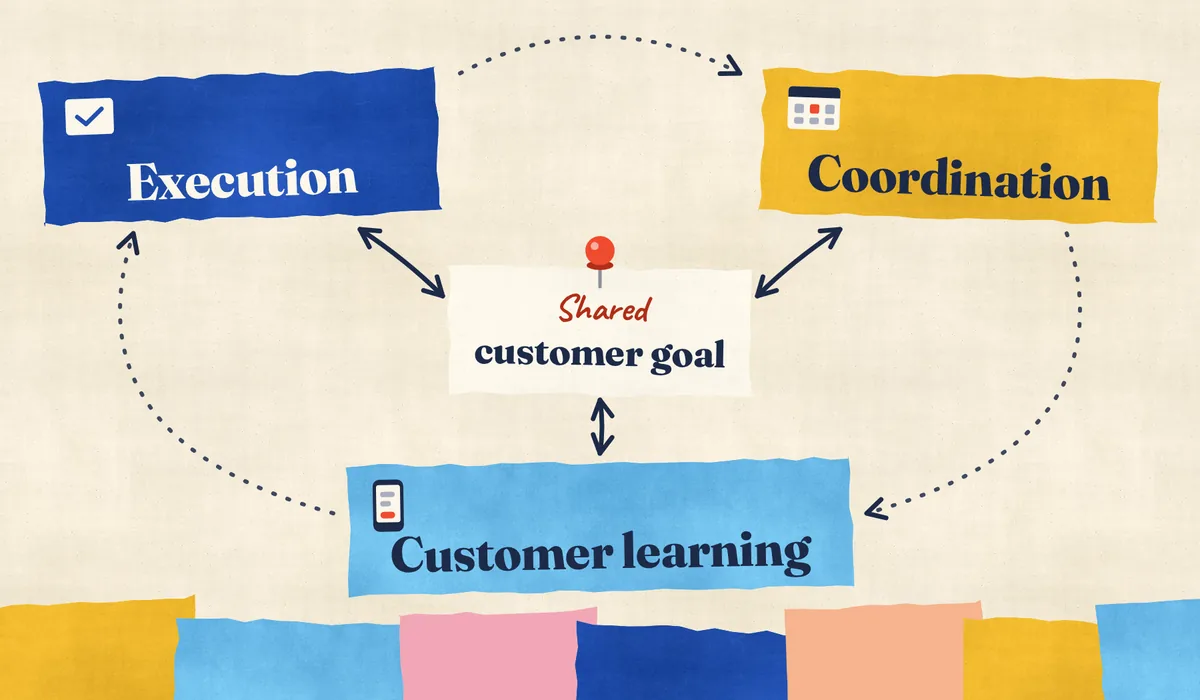
AI can affect each differently. A prototype may be ready before the team can recruit suitable participants. A fix may ship before enough customers encounter the failure to assess whether it helped.
For a team already using two-week Sprints, I would initially keep that cadence while measuring what changes. Shorten it if doing so solves a coordination problem.
Scrum already allows usable increments to be released during a Sprint. Teams can adjust the work toward the Sprint Goal as they learn.5 Customer evidence can inform decisions between formal events, and observation can continue across several Sprints.
Make the framework change decisions
Agile’s principles emphasize customer value, collaboration, adaptation, technical excellence, and sustainable work.4 Applying them takes more than adding an AI assistant to the existing ticket process.
In Sprint Planning, distinguish a familiar implementation from an investigation whose cause is still unknown. Forecast using the team’s recent completed work, including review, testing, integration, and rework. A quicker first draft may change only one part of that estimate.
At the Sprint Review, inspect the available customer evidence alongside the software. Decide what to continue, change, or investigate. Record what remains unknown and when to revisit it. An outcome that needs more observation should stay open after the implementation is complete.
Use the Retrospective to examine where AI saved effort and where it added correction or review. Choose one adjustment to the workflow and check whether it helped. These are practical uses of Scrum’s events, rather than new requirements of the framework.5
Kanban helps make waiting visible. Define where work starts and finishes, then track work in progress, throughput, work item age, and cycle time.6 If review or testing is persistently limiting completed work, help clear that constraint before starting more implementation. AI and automation can improve those stages too.
A single scenario in which changes are implemented faster than the team can review them. Watch it in 45 seconds, or change the rates in the model.
Read the transcript
- AI can speed up parts of product work.
- When generation outruns review, work starts waiting. Illustrative scenario: three changes proposed a day, two reviewed a day.
- Starting more work won’t clear this queue.
- Limit new starts. Finish what’s already underway. Review the queue first, then resume at a pace review can keep up with.
- Measure the customer result: successful payments, repeated attempts, recurring defects. Outcomes to measure, not results.
Try it: more proposed changes, same review
Keep business rules, architecture decisions, and known failure cases current so people and AI have useful context. Ground expected behavior in requirements and observed failures. A generated implementation and generated tests can agree with each other while sharing the same mistake. Preserve time for people to understand consequential changes and investigate failures.
That learning deserves attention. A randomized study of 52 developers learning an unfamiliar Python library found lower immediate quiz scores in the AI-assisted group. It measured learning on that task, rather than long-term skill loss.7
Bring discovery into the work sooner
As alternatives become easier to build, the team can test an important assumption before making a larger implementation commitment.
Keep observations, hypotheses, and proposed solutions distinct. Record their sources separately. AI can summarize real interviews; a person can propose an unsupported explanation. Trace important findings back to interviews, tickets, or behavior, and keep direct contact with customers.
Observations, hypotheses, and proposed solutions
Observations
Support tickets repeat the same payment error message.Tickets, summarized by AI, checked against a sample
In the prototype test, participants explained the message correctly and retried, and the retry still failed.Test sessions, noted by a researcher
Hypotheses
Customers misunderstand the recovery message.A team member, not yet checked
The payment provider rejects the retry.AI, from error logs
Proposed solutions
A clearer recovery message, prototyped and tested.AI-drafted prototype
Change how the retry is sent to the provider.An engineer
In prioritization methods such as RICE, revise effort when the cost of the complete change falls.8 Confidence in the customer benefit still needs evidence. A polished prototype gives the team something to test.
Revisit work that previously cost too much to justify: a recurring defect, an accessibility problem, or a difficult upgrade. Compare its revised cost and expected benefit with current feature commitments. Decide explicitly where any recovered capacity goes.
What this looks like in a CX team
In a hypothetical checkout example, the team is investigating abandonment after a payment error. Two explanations are plausible: customers misunderstand the recovery message, or the payment provider rejects the retry.
The PM, researcher, designer, and engineer examine the evidence together. AI helps organize support tickets, inspect logs, draft alternatives, and prepare tests. The team tests the assumption that most affects its next decision.
If participants understand the message but payment still fails, the team returns to diagnosis and changes the plan. That finding can prevent further investment in the wrong solution.
Before release, engineering and QA verify the recovery behavior, accessibility, and duplicate-charge protections. After release, the team evaluates payment completion after recoverable errors, repeat attempts, and related support contacts. A controlled rollout, where practical, helps distinguish the change’s effect from shifts in traffic or payment mix.
Those results feed the next decision: extend the change, revise it, investigate another cause, or stop. Discovery and delivery continue to inform each other.
Leadership has to make that adaptation possible. Teams need authority to revise scope and priorities, and capacity to act when evidence changes. An untouchable roadmap prevents earlier learning from changing the investment.
What I expect to see in 2027
My base case for 2027 is that AI adoption will spread faster than teams redesign their workflows. Where working practices remain largely unchanged, I expect three signs of strain:
- For comparable work, time to a first draft falls faster than time to a verified release, with more waiting in review or testing.
- More prototypes reach customer testing, while decisions wait for recruitment, observation, or interpretation. Improve avoidable delays while allowing the observation the decision requires.
- Some recurring fixes become cheaper to complete, but remain deferred behind existing feature commitments. That would reveal a prioritization choice worth reopening.
The review forecast would weaken if unchanged delivery workflows consistently absorb more AI-assisted work without longer waits or more rework. Check the other expectations against test-to-decision times and which recurring fixes actually ship.
For 2027, keep a clear customer goal and let new evidence change the plan. Retain a useful coordination cadence, measure delivery through verification, and decide explicitly where AI saves effort and where to reinvest it.
Agree which customer, reliability, or cost result each investment should improve, then check whether it did. Agile earns its place when that feedback changes what the team does next.
Written November 1, 2026. The forecasts and proposed practices are my interpretation of the evidence.
Sources
- Cui et al., The Effects of Generative AI on High-Skilled Work: Evidence from Three Field Experiments with Software Developers, Management Science (opens in a new tab), published online February 27, 2026. Randomized experiments at Microsoft, Accenture, and an anonymous Fortune 100 company; the pooled estimate concerns completed development tasks. ↑
- DORA, State of AI-assisted Software Development 2025 (opens in a new tab). Survey and qualitative research; the cited relationships are observational. See also DORA’s discussion of throughput and instability (opens in a new tab). ↑
- METR, We Are Changing Our Developer Productivity Experiment Design (opens in a new tab), February 24, 2026. Explains selection and time-measurement limitations in follow-up experiments. ↑
- Principles Behind the Agile Manifesto (opens in a new tab). ↑
- Schwaber and Sutherland, The Scrum Guide (opens in a new tab), November 2020. Official guidance on goals, adaptation, events, and increments; the suggested applications here are the author’s recommendations. ↑ ↑
- The Kanban Guide (opens in a new tab), May 2025. Definition of Workflow, work-in-progress controls, and the four flow measures. ↑
- Shen and Tamkin, How AI Impacts Skill Formation (opens in a new tab), 2026. Small randomized study of immediate learning on unfamiliar tasks. ↑
- Intercom, RICE: Simple Prioritization for Product Managers (opens in a new tab). Effort covers team time; the proposed allocation of recovered capacity is the author’s recommendation. ↑