Your next customer might be an AI agent
I started out building the pages shoppers clicked through. Now I work on the agent that answers them.
I started as a frontend developer. Seven of my 14+ years in digital were on one e-commerce site, where I grew from frontend developer to technical product owner to product manager. For most of that time, the job was the path: search result, landing page, category, filters, product page, cart. If a shopper got lost, we fixed a page.
Today I’m a product manager in digital commerce at Kohler, and part of my work is the AI shopping agent on our site. I was its product manager from implementation through launch. I’ve worked on every release since.
Sitting that close changes how you see shopping. Many shoppers don’t type a product name into our agent. They type their actual problem, the way they’d say it to someone in a showroom:
“Will this valve work with the trim I already have?”
Three years ago, that question meant a search, five open tabs, a spec sheet, and maybe a call to a plumber. Now it’s one sentence in a box. And the shopper expects one good answer back.
Three things the agent taught me
Usage tells you it’s popular, not that it’s right. After launch, the usage numbers couldn’t tell us the one thing that mattered: were the answers correct? So I went through real shopper questions and sorted them by where the answers failed. Then we built evals that grade answers against known-good examples for each product line. Now I keep improving the agent from what the evals and customer feedback show.
The answer is only as good as the product data. When I traced weak answers back to their source, the model often wasn’t the problem. The product data was. A missing dimension, say, or a compatibility detail that never made it into the product record. So now I spend real time recommending data fixes to our catalog teams. Those fixes help every shopper on the site, not only the ones who chat.
Boundaries are part of the experience. Part of the job is writing the guardrails: what the agent should answer, what it shouldn’t, and when it should hand off. A shopper forgives “I’m not sure, here’s who can help.” They don’t forgive a confident wrong answer on a $1,000 purchase.
Meanwhile, the whole industry moved
When this year started, most of what I saw outside our walls was pilots. Nine months later? It’s becoming the default:
- January. Google introduced an open standard for agent shopping with Shopify, Etsy, Wayfair, and Target. It also started rolling out checkout inside AI Mode and Gemini. The Home Depot turned its Magic Apron assistant into a project expert you can talk to, one that knows local inventory down to the aisle.
- March. OpenAI stepped back from checkout inside ChatGPT. Shoppers still discover and compare there. Then they finish on the retailer’s own site.
- First quarter. Adobe saw AI traffic to US retail sites grow 393% year over year, and by March it converted 42% better than other traffic. Shopify saw orders from AI searches grow nearly 13x.
- May. Amazon put Alexa for Shopping in its main search bar for every US customer. Its predecessor, Rufus, reached more than 300 million customers in 2025 and helped bring in nearly $12 billion in incremental annualized sales.
- This holiday. Adobe expects AI traffic to US retail sites to climb 130%.
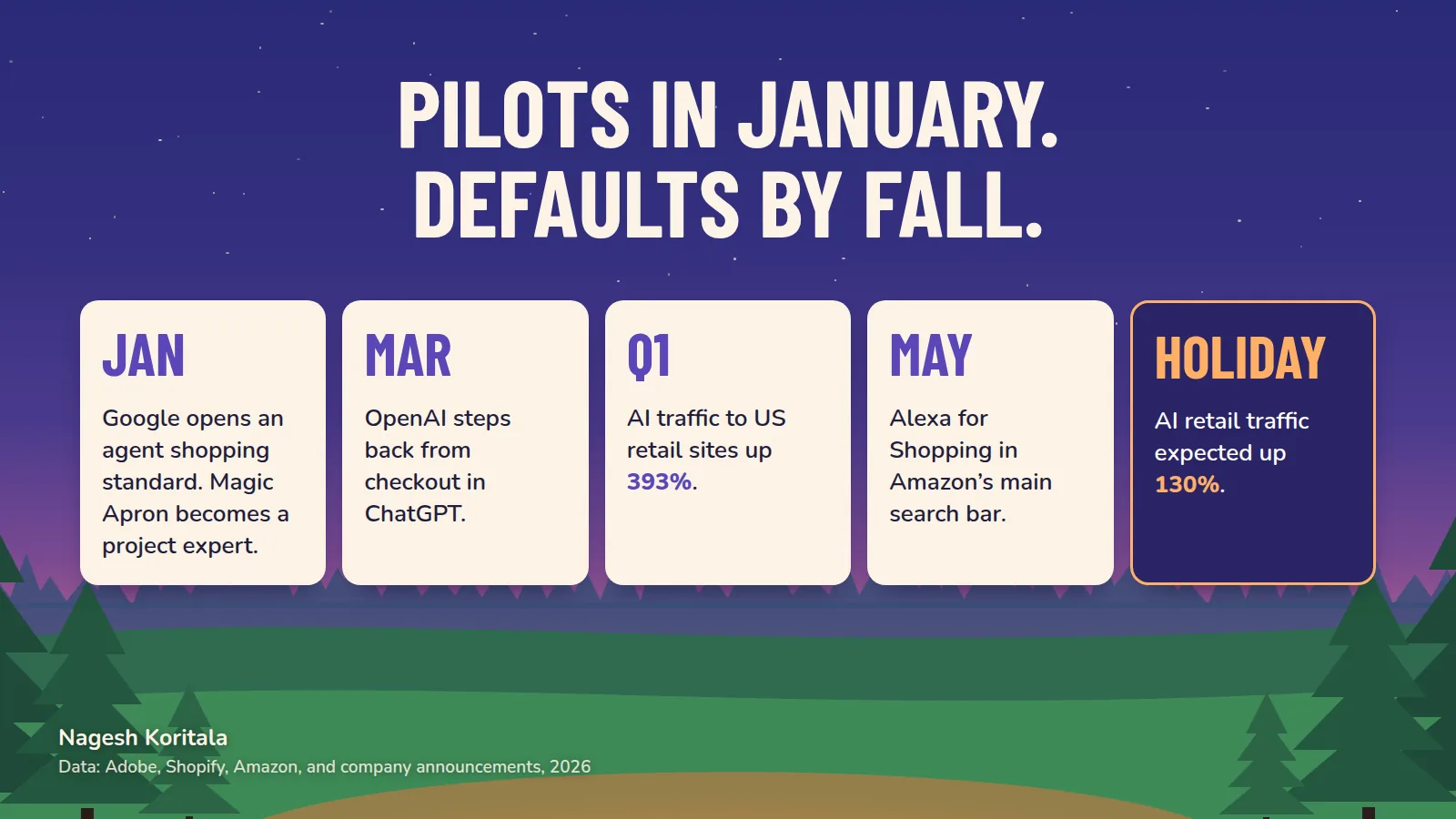
What I take from it: the conversation can start anywhere now. Google, ChatGPT, a retailer’s own search box. But when OpenAI pulled checkout back to retailers’ sites, it showed where trust still lives. The brand still has to earn the yes.
Every product now has two shoppers
The products I work on are considered purchases. A shower system can have more than 15 parts, and they all have to work together. For years, customers often found out too late that something didn’t fit. That’s exactly the kind of decision people now want to talk through, not click through.
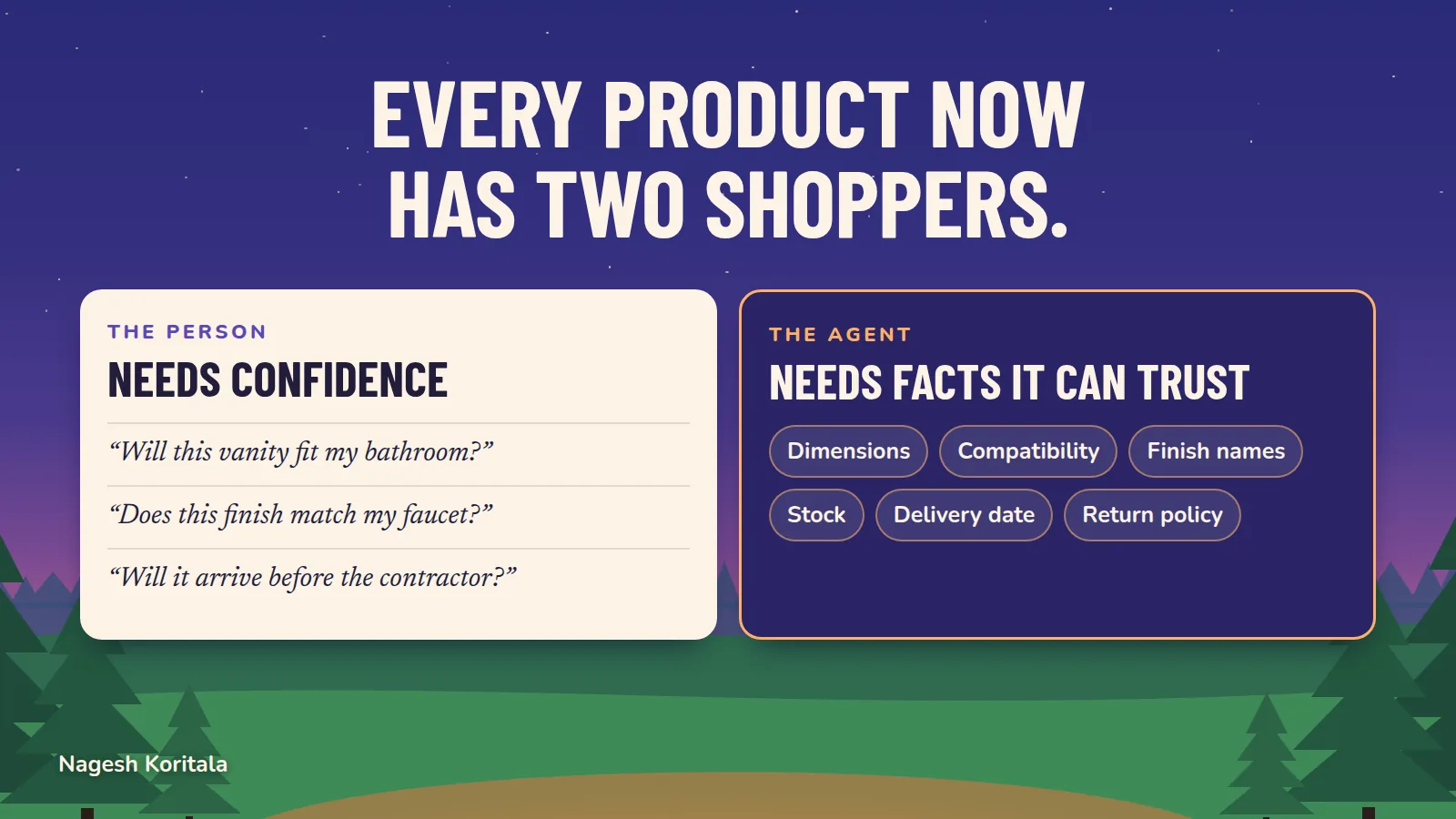
So I think about two shoppers for every product:
- The person needs confidence. Will this vanity fit my bathroom? Does this finish match the faucet I already have? Will it arrive before the contractor does? They used to answer these by browsing. Now they just ask out loud.
- The agent needs facts it can trust. It doesn’t look at the lifestyle photo. It reads dimensions, compatibility, finish names, stock, delivery dates, and the return policy. Then it judges you on whether they’re clear and current.
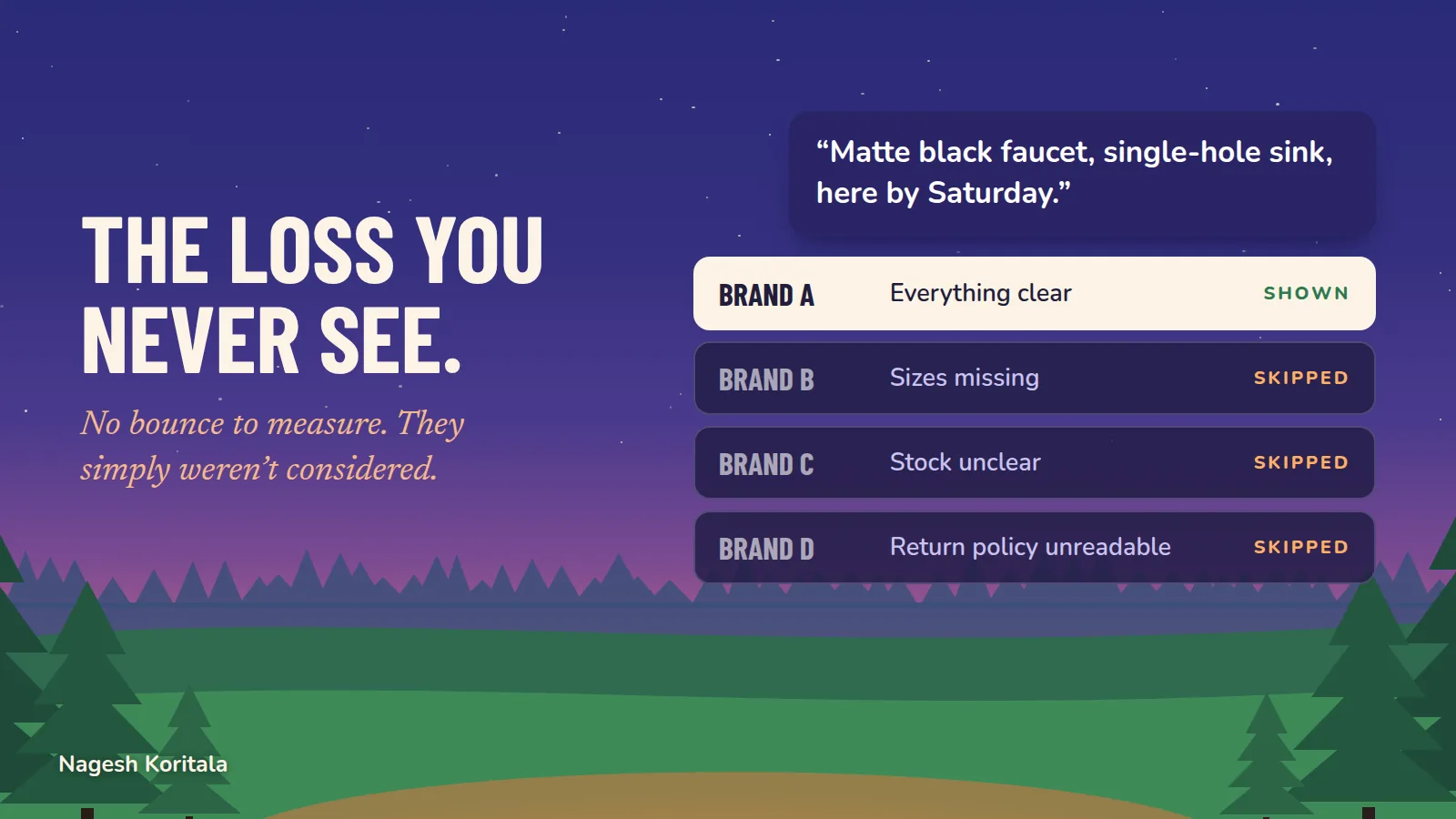
Here’s what worries me. Say a shopper asks an assistant for a matte black faucet that fits a single-hole sink and arrives by Saturday. The assistant quietly skips any brand whose sizes are missing, whose stock is unclear, or whose return policy it can’t read. Those brands never see the shopper. There’s no bounce to measure. They simply weren’t considered.
Six moves, and where I am with each
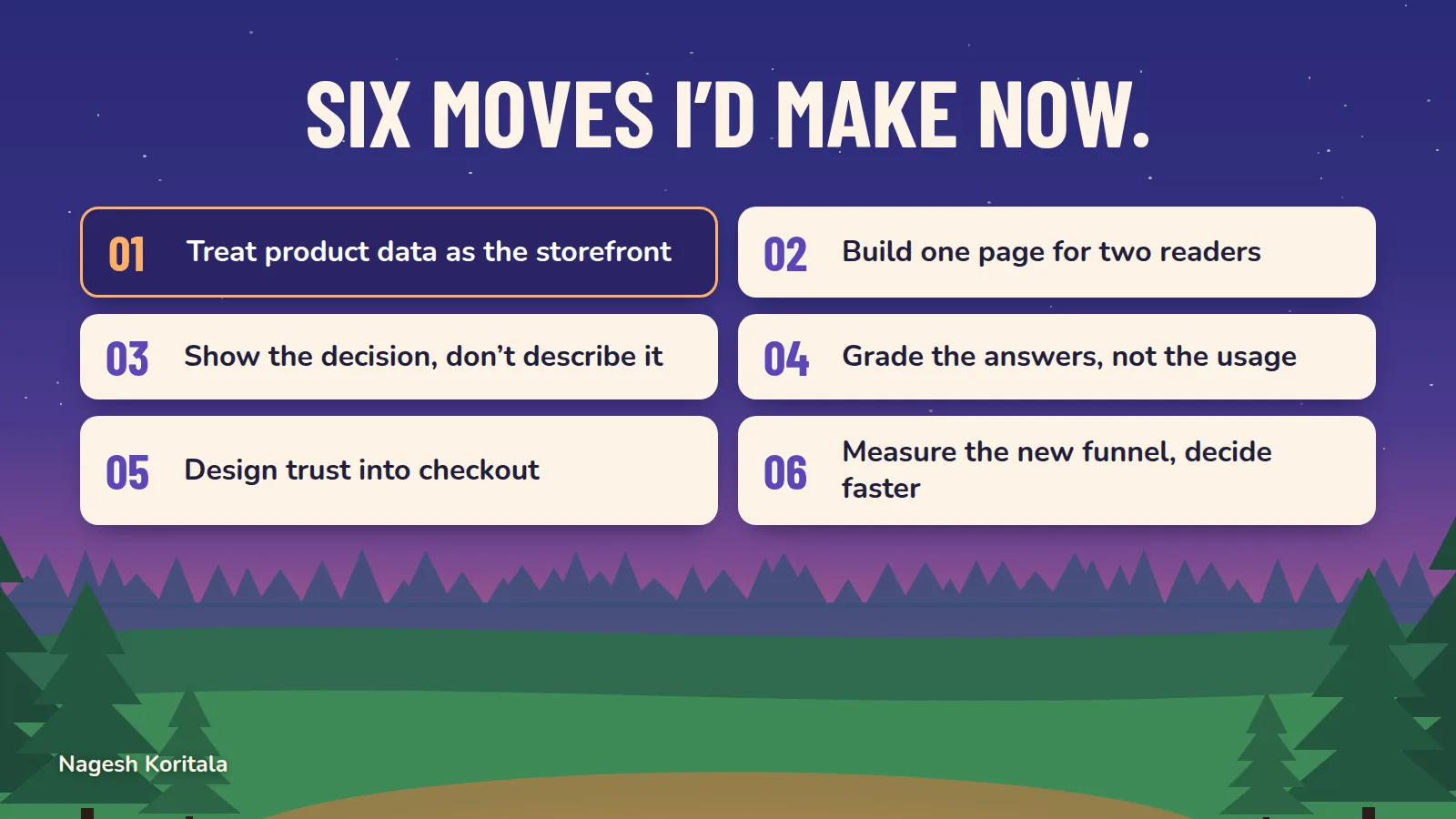
- Treat product data as the storefront. Agents read attributes, not banners. This is where I’d put the first dollar. Recommending product data fixes to our catalog teams is one of the steadiest ways I’ve found to make the answers better. And it helps shoppers who never open the chat.
- Build one page for two readers. Your product page has two readers now: a person making up their mind, and an agent pulling facts off it. So the facts have to match in both places. What the person sees and what the agent reads should never disagree, especially on price and stock.
- Show people the decision, don’t describe it. For our shower systems, I sized the opportunity from category growth and customer feedback. Then I built working prototypes of a guided flow on real product data, where every part you pick is checked for fit. Leadership approved it after clicking through it. Conversational shopping will need the same habit: prove the experience before you argue for it.
- Grade the answers, not the usage. “Will this fit?” deserves a yes, a no, or a clear “here’s how to check.” Never a list of colors. Build evals from real customer questions, by product line, and keep improving from what they show. That’s how we run our agent today.
- Design trust into checkout. “Tell me the total first” is a product requirement. When I worked on our payment options, I ranked Apple Pay, Google Pay, PayPal, and Affirm by how much each could reduce drop-off at the payment step. Hand an agent a card and the bar goes up again: spending limits, a clear confirmation, and delivery updates. Visa and Mastercard are building those rules into their networks now.
- Measure the new funnel, and decide faster. Track AI referrals and agent-led orders as their own channel. Every week, read the questions you couldn’t answer. And speed up decisions, not only releases. If a data fix takes a quarter to approve, the agents will have moved on.
What changes for product managers
When I started, my job was to make the path from a click to a cart a little smoother. That job still matters. But it’s getting smaller. The bigger job now is designing decisions that happen in places we don’t own, like someone else’s chat window. The shopper may never see our homepage, and the agent helping them judges us on facts.
Honestly, I find that exciting. It rewards the unglamorous work I’ve always cared about: clean data, honest answers, clear policies, and a checkout that asks before it spends. It also rewards PMs who still build things themselves. The fastest way to understand an agent is to put real questions in front of one and read what comes back.
Your next customer might be an AI agent. But the person behind it still decides whether to come back.
I’m curious: if an agent shopped your category tomorrow, what would it get wrong first about your products? Tell me, or reply on LinkedIn.
Sources
- Google’s agent shopping standard and checkout in AI Mode: Google, 9to5Google, Jan 11, 2026
- The Home Depot Magic Apron: Google Cloud, Jan 11, 2026
- OpenAI steps back from in-chat checkout: CNBC, Mar 20, 2026
- AI traffic to US retail sites, first quarter: Adobe, TechCrunch, Apr 16, 2026
- Orders from AI searches: Shopify Q1 2026 earnings call
- Rufus results: Amazon Q4 2025 results
- Alexa for Shopping: Retail Dive
- Holiday forecast: Digital Commerce 360, Sep 29, 2026
- Card networks and agent payments: Visa, Mastercard
These views are my own. The industry numbers come from the companies and reports above. I’m not sharing any internal results here.